The Hidden Work AI Agents Do During Voice Calls
Voice AI is not only a speaking interface. Learn how AI agents retrieve records, check policy, use tools, prepare actions, and update workflows while a support call continues.
The Hidden Work AI Agents Do During Voice Calls
The Hidden Work AI Agents Do During Voice Calls
A voice call sounds linear. A customer speaks, an agent responds, the customer clarifies, the agent answers again. From the outside, support looks like a sequence of turns.
Inside a modern AI support system, much more is happening.
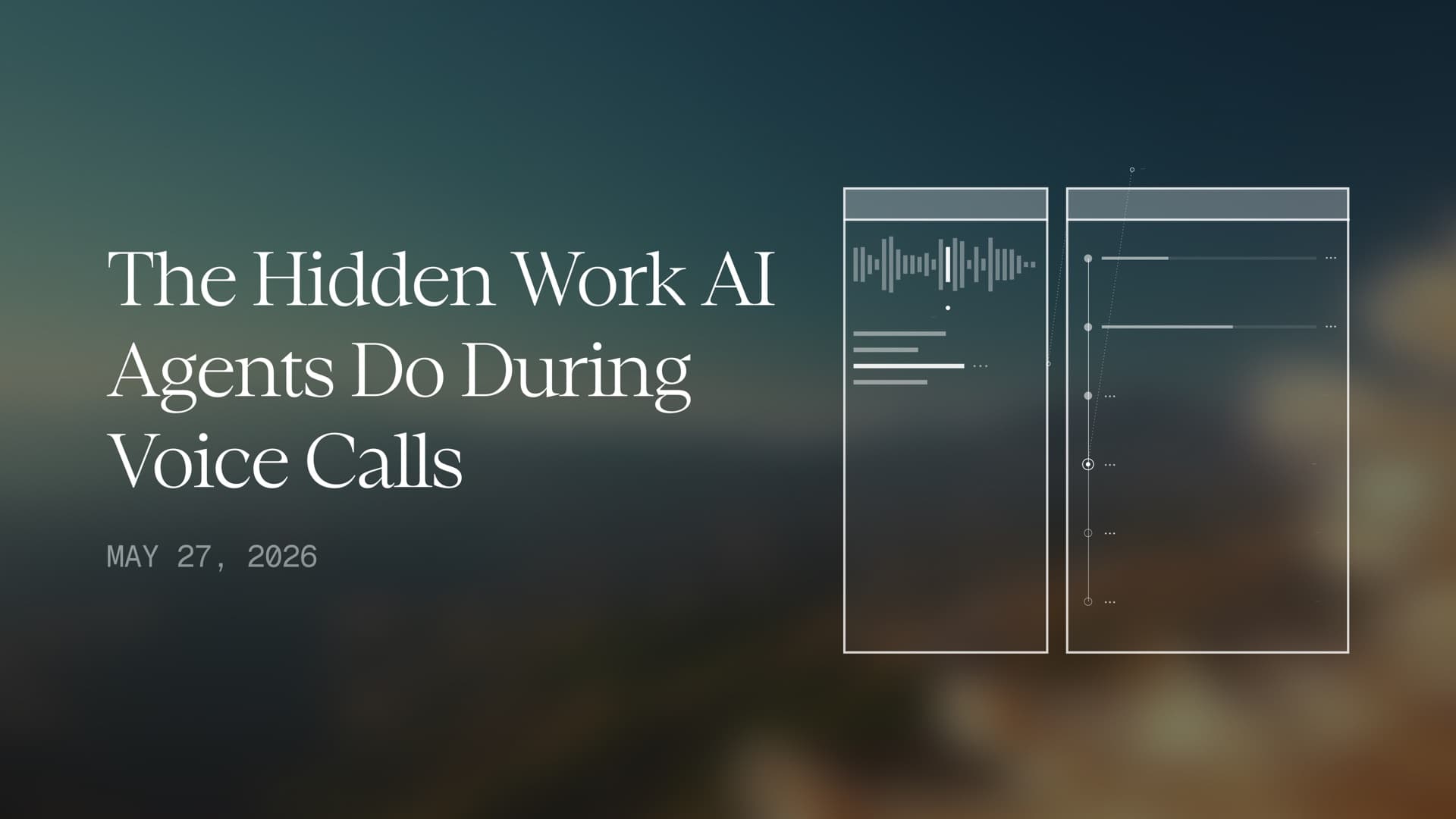
While the customer hears a natural conversation, the agent can retrieve records, inspect policy, classify intent, call tools, update a ticket, prepare a handoff, trigger a browser workflow, and decide whether the next response should ask, act, confirm, or escalate.
Voice is the visible layer. Work happens underneath.
That distinction matters because many teams still evaluate voice AI as if it were mainly a speech problem. Does the voice sound natural? Does the response arrive quickly? Can the system handle interruptions? Important questions. Incomplete questions.
A support call is not successful because the agent spoke well. It is successful because the customer’s problem moved closer to resolution.
Voice gives the system time to work
Text-based support creates a strange expectation. Every response appears as a finished object. The customer sends a message, waits, and receives a block of text. Any delay is mostly invisible until it becomes annoying.
Voice creates a different interaction pattern. Small pauses, confirmations, and clarifying questions can be natural when they are useful. A good human agent already does this. They say, “Let me pull that up,” or “I’m checking the order now,” or “Give me one second while I verify the policy.” The conversation continues while the work happens.
AI voice agents can use the same space, but the underlying work can be more complex. A call can provide enough conversational surface for background retrieval, tool use, and workflow execution to happen without forcing the customer into silence.
This is not filler. It is runtime design.
The agent’s spoken behavior should give the system enough room to do the right work, while still making the customer feel the call is moving. Bad voice AI either talks too much while doing nothing or pauses too long while doing something. Strong voice AI uses conversation to cover real progress.
The background loop
A useful support call usually requires a loop, not a single answer. The agent needs to understand the customer, map the issue to a scenario, gather missing context, check the relevant policy, inspect available tools, take action, record the outcome, and decide whether the issue is resolved.
|
What happens during a live voice call
Consider a customer calling about a delivery issue. They are not asking for a general explanation. They need a decision: where is the order, what happened, what options exist, and what happens next.
During that call, an AI agent may need to do several things at once. First, it has to identify the issue. Delivery late, address wrong, driver unavailable, item missing, refund request, or account mismatch. Each route implies different tools and policies.
Next, the agent needs context. Order status, customer profile, delivery window, driver notes, prior contact history, location data, and refund eligibility may all matter. If the customer is speaking another language, translation must also preserve the operational meaning of the request.
Policy comes after context. A refund policy may depend on timing. A delivery exception may depend on merchant status. A human escalation rule may depend on safety, account value, regulatory constraint, or customer frustration. The agent needs to know which rule applies before speaking with confidence.
Finally, the agent may need to act. Open an internal tool. Update an address. Trigger a follow-up. Create a ticket. Send an SMS. Transfer to a human with context. Confirm a resolution. Store the result.
A caller hears a support conversation. The system is running a workflow.
Why browser agents matter in voice support
Many support operations still depend on web-based internal tools. APIs may exist for some actions, but not all. Older systems may be difficult to integrate. Internal workflows may require screens, forms, searches, confirmations, and status checks.
This is where browser agents become important. A browser agent can let the AI act inside systems that were built for human operators. That turns voice AI from a conversational layer into an execution layer.
A customer does not need to know whether the backend action happened through an API, browser workflow, CRM integration, or support platform. They care whether the problem was handled. The support team cares whether the action was correct, logged, governed, and measurable.
Voice plus browser execution changes the shape of automation. Voice keeps the customer engaged. Browser execution moves the case forward. Policy and analytics determine whether the system should continue, ask for more information, or hand off to a person.
The latency tradeoff
Every background action consumes time. Speech recognition takes time. Translation takes time. Retrieval takes time. Reasoning takes time. Browser actions take time. Text-to-speech takes time. A support system has to budget for all of it.
Latency is not only a technical metric. It is the size of the agent’s thinking window.
If the system optimizes only for fast responses, it may skip useful reasoning or act before gathering enough context. If it optimizes only for deep reasoning, the call may feel slow and broken. Strong product design sits between those extremes.
A natural voice experience should make the system feel responsive while giving the agent enough time to do useful work. Short confirmations, context-setting phrases, and targeted clarifying questions can be part of that design. They should never become theater.
Customer support is not a Turing test. A caller does not need a perfect imitation of a human. They need the agent to understand the issue, move quickly, recover from uncertainty, and complete the support task.
Hidden work needs visible controls
Background execution creates leverage. It also creates risk.
Once an AI agent can retrieve records, use tools, update systems, or operate a browser, the organization needs controls. Which tools are available? Which actions require confirmation? Which policies apply? Which workflows are safe for automation? Which cases must transfer?
This is why voice AI cannot be separated from agent orchestration. A serious system needs instructions, permissions, scenario routing, policy grounding, logging, and post-call measurement. Agent Canvas is the kind of surface where this work becomes operational rather than improvised.
Hidden work should not be invisible to the business. It should be logged, explainable, and tied to outcomes.
The ticket is part of the product
A support call does not end when the voice stream ends. The operational record matters.
A strong AI support workflow should capture what the customer asked, what the agent understood, which policies mattered, which tools were used, what action was taken, whether the issue was resolved, and what should happen next. Without that record, automation creates short-term convenience and long-term ambiguity.
For multilingual calls, this becomes even more important. Original language, translated meaning, customer intent, agent action, and support outcome all need to remain connected. A translated conversation should not split into multiple partial histories. It should become one useful support record.
The ticket is not clerical residue. It is the memory of the workflow.
What support teams should evaluate
Teams evaluating AI voice agents should look past the demo voice. A polished conversation matters, but it is not the deepest product question.
Better questions include: What work happens while the agent is speaking? Which tools can the agent use? How are actions logged? How does the system decide between asking, acting, and escalating? How does the agent recover when a tool fails? How does the business know whether the call was actually resolved?
A good demo should show the visible conversation and the hidden workflow side by side. The customer hears natural support. The buyer sees record retrieval, policy use, tool actions, ticket updates, and resolution measurement.
The real product is the loop
Voice AI becomes valuable when the conversation and the work stay connected.
A call without backend action is just a better interface for delay. A backend action without conversational clarity creates customer confusion. A ticket without measurement leaves the team unsure whether automation helped.
The real product is the loop: listen, reason, act, record, measure, improve.
Customers will not describe it that way. They will say the agent handled the problem. Behind that simple sentence sits the hidden work of a modern support system.
That work is where voice AI becomes support AI.