How we built Giga Racer in two days
Racer cuts the marginal cost of crafted sales and marketing material. It’s built on the decks we obsessed over by hand, so every new piece meets the bar we’ve always set for Giga.
Everything we put in front of a prospect is made with care: the deck for a sales call, the one-pager left behind after it, the post that brings them to us. Each piece used to take hours of back-and-forth between sales and design, and the next one cost just as much. We wanted the hundredth piece to look as considered as the first, at a fraction of the cost.
Giga Racer is our internal studio for that work. A seller types one sentence, attaches what they have, and gets an on-brand deck, one-pager, or post for that prospect. We didn’t ask a model to learn our taste from scratch. We built Racer on material we had already made by hand, detail by detail, so it holds every new piece to the standard we’ve always set, on any surface.
We made the first commit on Monday, and by Tuesday afternoon it worked. Two days was enough because of one design decision: the model doesn’t design. It writes the words, chooses from a fixed set of layouts, and names the pictures. The design system owns the grid, the type, and the spacing.
The design system started as one deck, built by hand.
The day before the first commit, Juan built a sales deck by hand in our design system. That deck became the golden template: the grid, the layouts, and the type that every Racer document starts from. Every deck, one-pager and post is laid out by the system, never by hand.
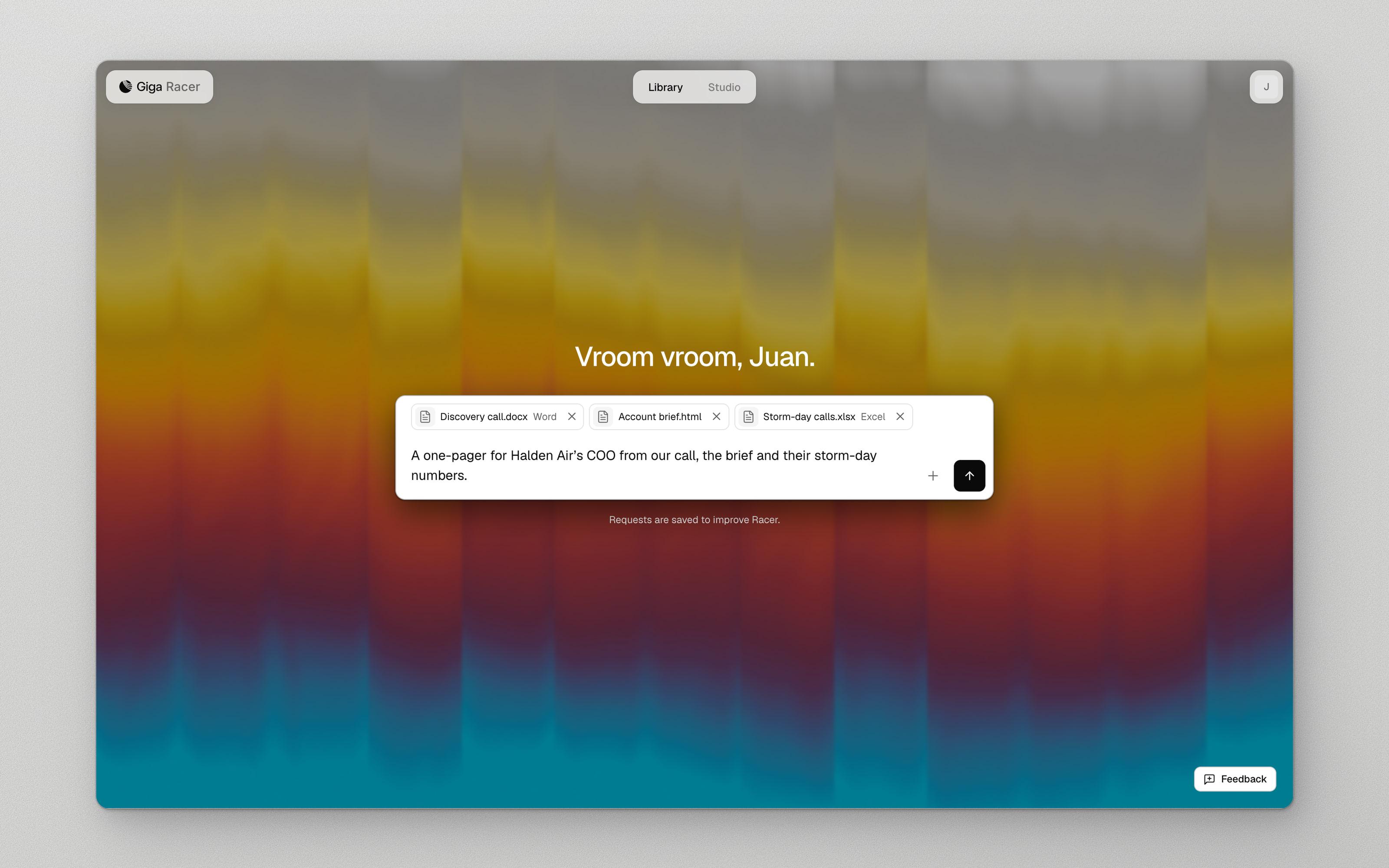
Racer chooses a template; it doesn’t generate one. From a call transcript, an account brief, a spreadsheet of storm-day calls, and one sentence, Racer picked a travel and hospitality template, found the logo, and adapted the copy.
00:00
−00:00
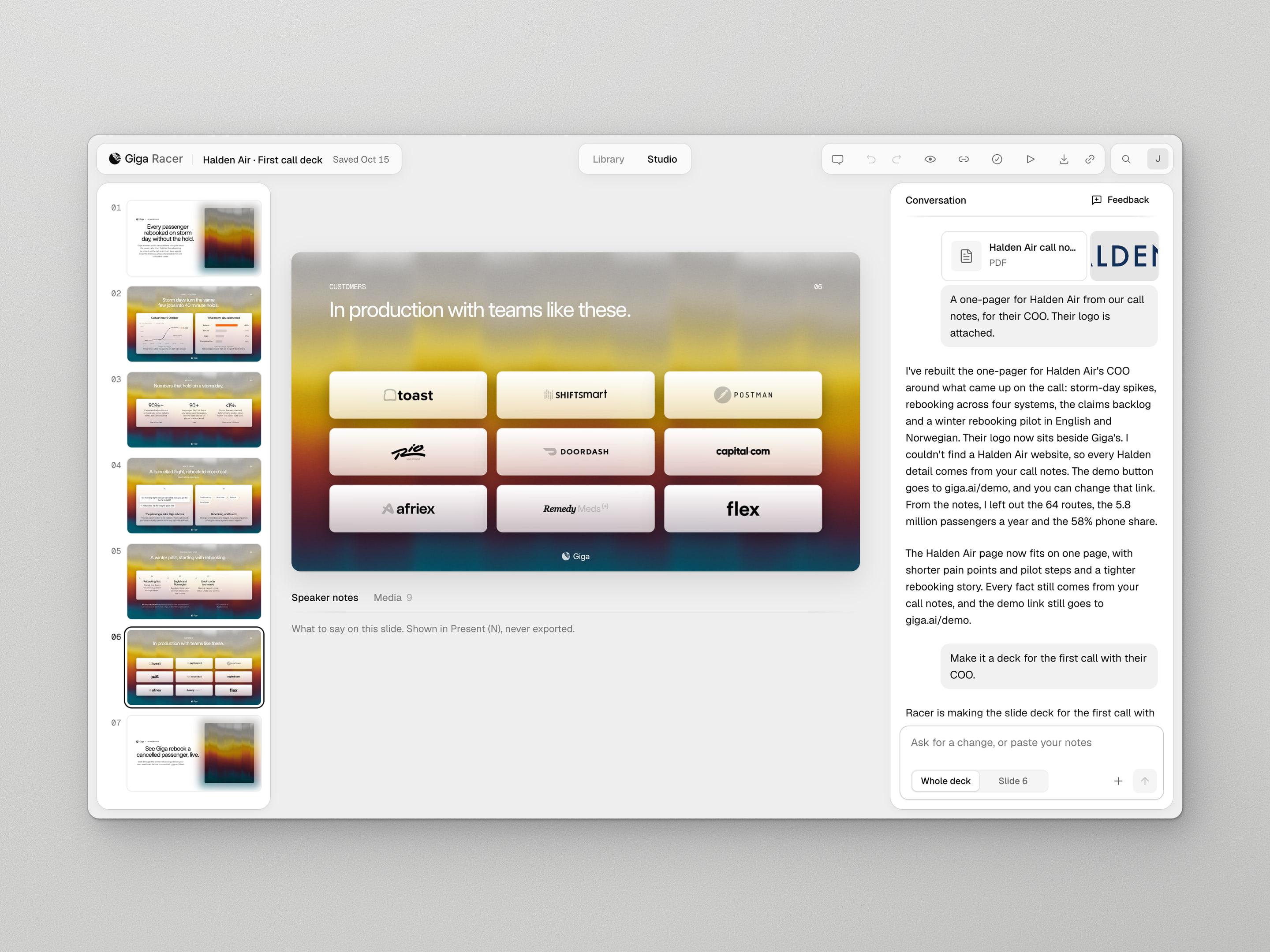
The components are shared across formats, so Racer can rebuild a document in a different layout. Asked to convert the one-pager into a deck ahead of a COO call, it produced seven slides in roughly a minute.
00:00
−00:00
The model writes words and numbers, and Racer draws the rest.
Slides sit on a fixed grid with a small set of layouts, and resizing by hand is restricted. The model fills those parts with words and chooses among them.
Changes come back as edits, not rewrites. Point at a heading, press “C”, and Racer changes that part only, leaving the rest of the slide exactly as it was.
00:00
−00:00
Charts follow the same split. The model writes only the numbers it was given and Racer draws the chart, so a missing number becomes a note to the seller instead of a made-up bar.
Logos are scaled by visual weight: the ink, not the bounding box. A bold logo and a thin one at the same width don’t look the same size.
Racer checks its own page before anyone sees it.
A model that only fills parts can still fill them badly: a headline too long for its box, a gap where nothing sits. So after every change Racer renders the page and measures it against the layout rules, looks at a screenshot of anything it made, flags anything that looks off, and fixes what it can. On a test one-pager it found a gap above the headline and closed it without blocking the download.
00:00
−00:00
A Racer deck is a live page, not a set of pictures.
Each slide stays interactive while you present. Point at a step and its screen lights up, or click a chapter or the timeline under a demo to jump to that moment.
A demo plays automatically when its slide appears. After a few seconds, it enters focus mode: the phone expands to the full height of the slide and everything around it dims. Pressing Esc or clicking anywhere returns the slide to normal. The shared link and HTML download work the same way.
00:00
−00:00
When you present, the deck uses two screens. Speaker notes stay off the screen you share and appear on your phone, with next and previous buttons and your talk track.

Share turns the deck into a link the prospect can open anywhere, without the notes. It shows whether the deck was opened, by how many people, and how long they spent on each slide.
00:00
−00:00
Two review passes read every new line Racer writes.
A deck can look right and still read like every other vendor’s. Racer writes to our house style, and we use Spiral to improve the writing.
After each reply, two passes read the new lines. Racer’s line editor marks the few that break a rule, the way an editor marks a proof. Then Giga’s voice cuts lines any company could write. Guardrails stop either pass from adding a figure, a name, or a new claim.
Edits arrive as suggestions you accept or dismiss, ⌘Z undoes them, and a single keystroke re-reviews the whole document. On anything a prospect reads, Racer traces figures and absolutes to a source and suggests a corrected line wherever one overreaches.
00:00
−00:00
Racer logs which suggestions people accept or dismiss, so it learns which ones are worth making. It now writes posts for giga.ai/news by the same rules.
We measure the time from request to sent.
A deck in a minute tells us little. We measure how long it takes our team to go from a request to a document they’re ready to send.
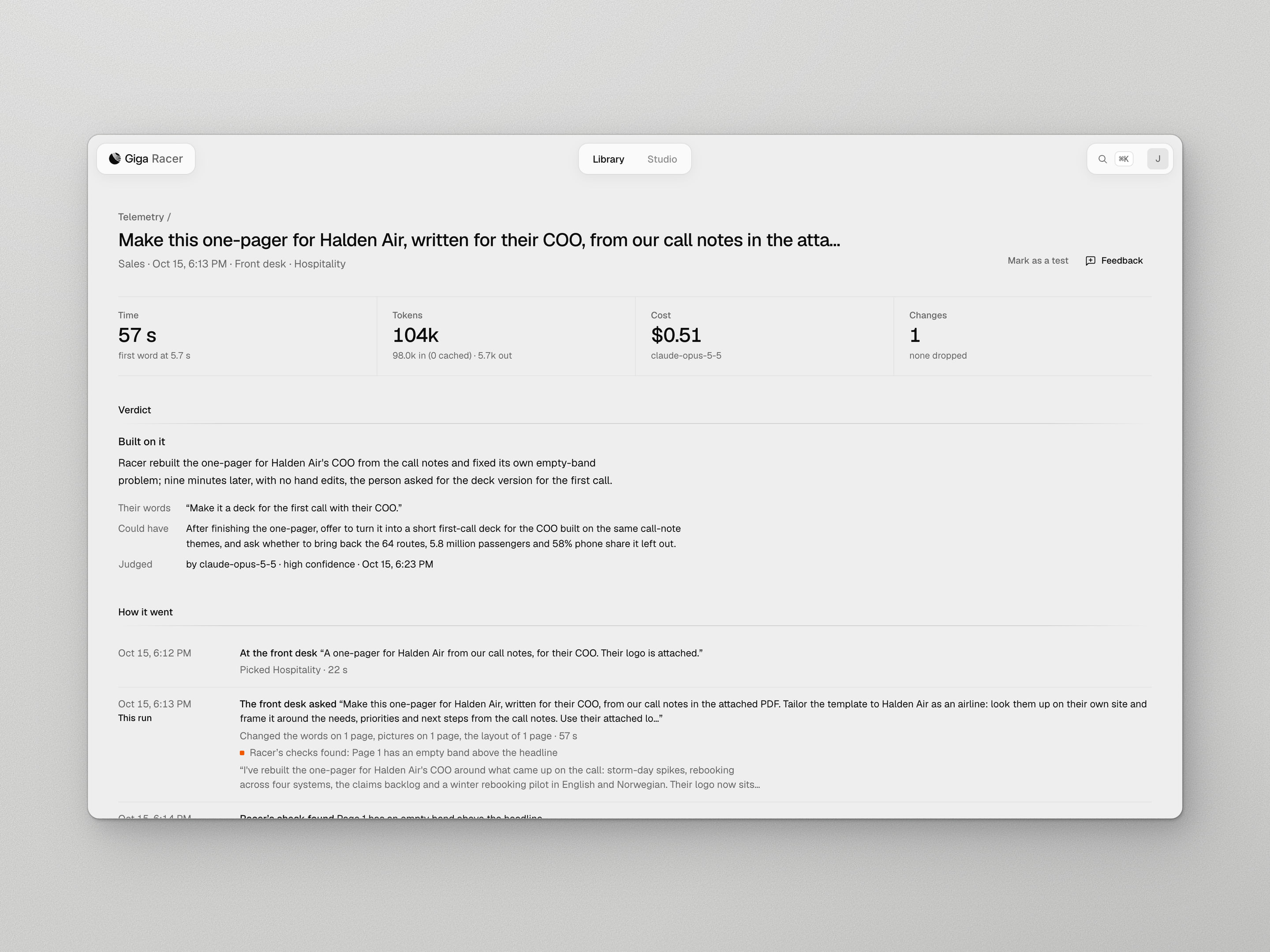
Every change request is logged. An auditor agent reads what was asked, what Racer did, and what happened next: whether the teammate edited by hand, undid the change, or gave it a thumbs down. It sorts each turn into one of four outcomes:
- Right the first time.
- A miss by Racer, and where it missed.
- The teammate changed their mind.
- A next step Racer should have offered.
The last one matters most. On a test one-pager, the auditor noted that Racer should have offered “to turn it into a short first-call deck for the COO”. The user had to ask.
An admin can take any request Racer got wrong, run it again on the current version, and see the old and new answers side by side. Rules also come from the team. Racer keeps each line someone rewrites next to the line it originally wrote. When the same edit keeps appearing, its weekly report proposes a house rule for one of us to approve.
Corrections don’t disappear into a PDF. They become the next rule.
Teammates work in the same deck at once.
One seller writes the deck for a big call, another checks the numbers, and design gives it a final look. In the week after the first two days, we moved that back-and-forth into Racer.
When a teammate opens your deck, their face shows at the top and their pointer moves across your slide with their name on it. You see what they type as they type it. Undo takes back only your own changes, and two people editing at once end up with one deck.
00:00
−00:00
To bring someone in, @-mention them in a comment, and they’re notified in Racer and in Slack. When the deck is ready, Review sends it for a peer review.
The next version closes any loops still open.
Racer is internal for now. Three loops are coming next:
- A nightly pass. It reads the day’s manual changes, proposes rules, tests them on those misses, and ships them. The change log stays open, so the team can see and comment on how Racer changes.
- Outcomes, not just edits. Linking a document to the sales calls it was used in and to what the prospect read, so we agree on what “useful” means.
- Use the wait. While the model works on a change, Racer would use that time to refine it further: the right image, the right part of the deck, one-pager, or post.
Most tools start a deck from a single sentence. Ours start from the decks we made by hand, so the next one costs less and looks just as considered.
The examples use a made-up company and sample data.

The Giga Times, by email
See what Giga would resolve at your company.
Enter your work email to see what they’d resolve.